
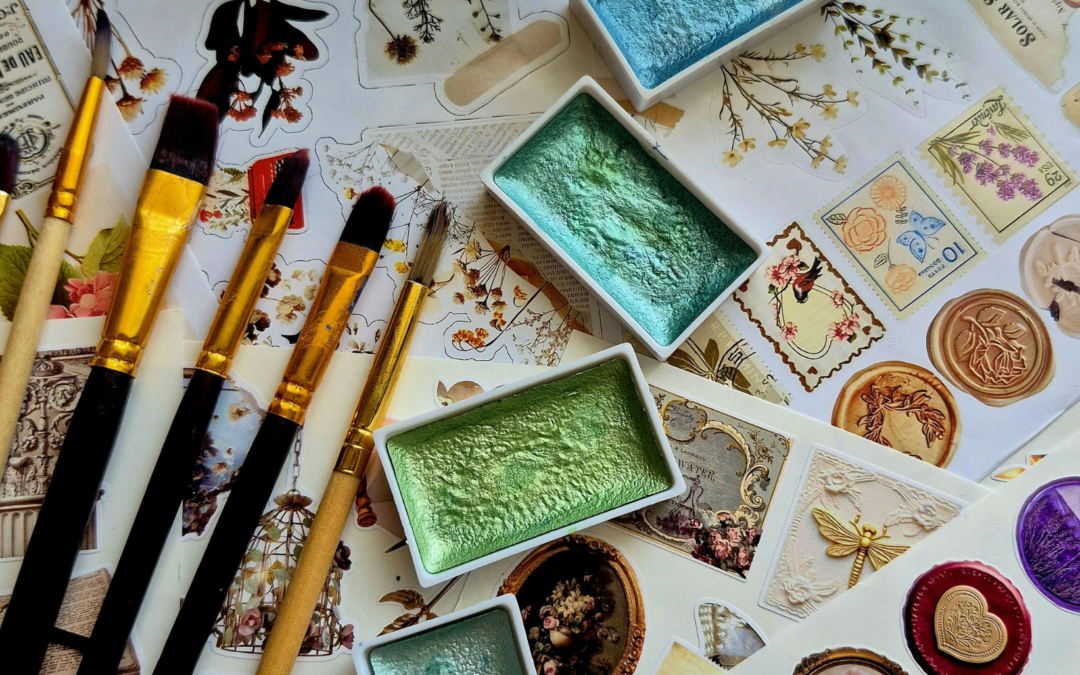
There is something that happens when you hand a woman a paintbrush and tell her there are no rules.
Sometimes she freezes. Sometimes she laughs nervously. Sometimes, after a long pause, she starts to cry. Not because anything is wrong, but because something, finally, feels safe.
That reaction is not accidental. It is what art therapy was designed for. Not to create beautiful things. Not to measure talent. But to open a door that words, for many people, have never quite been able to reach.
If you have experienced trauma, and many women of color have, in ways that are both deeply personal and structurally inflicted, you may have noticed that talking about it only goes so far. You can describe what happened. You can name the feelings. And still, something remains lodged somewhere deeper, in the body, in the nervous system, in the place where language runs out.
That is where art therapy activities meet you.
What is Art Therapy?
Art therapy is a therapeutic modality that uses the creative process, drawing, painting, collage, sculpting, movement, as a way to access, process, and integrate experiences that are difficult to express verbally. Art therapy is not an art class. It is facilitated by a trained therapist, not an art instructor, and the goal is never the finished product.
For trauma survivors especially, Art tTherapy activities offer something that traditional talk therapy alone sometimes cannot: a way to externalize internal experiences without having to rely on words alone. You do not need to explain it. You just need to make something that can represent the experience.
Research supports Art Therapy as an effective approach to reduce symptoms of PTSD, lower anxiety, improve emotional regulation, and support the kind of nervous system healing that trauma disrupts at a physiological level. (Kaimal, G., Ray, K., & Muniz, J. (2024). Effectiveness of trauma-focused art therapy in reducing PTSD and depression symptoms and improving emotional processing. The Arts in Psychotherapy, 89, 102171. https://doi.org/10.1016/j.aip.2024.102171)
And for women of color navigating the specific, layered weight of racialized trauma, intergenerational wounds, and the ongoing exhaustion of surviving in spaces not built for them, Art Therapy activities can offer a rare opportunity to reduce the mental load of sharing the lived experience.
7 Trauma-informed Art Therapy Activities
These are not DIY exercises to complete alone at your kitchen table. They are approaches used within the therapeutic relationship, guided by a trained clinician who holds the space with intention and care.
- The safe place drawing
Before trauma can be processed, the nervous system needs to find regulation. This art therapy activity invites you to draw or paint a place, real or imagined, where you feel completely safe. The act of externalizing safety, making it visible and tangible, can help the body begin to access that feeling rather than just intellectually recall it.
- The body map
Trauma lives in the body. The body map art therapy activity involves drawing an outline of your own body and then filling it in with colors, images, words, and textures to show where you carry things. Fear in the chest. Grief in the throat. Numbness in the hands. Many people are surprised by what emerges. That surprise is information.
- Collage for identity
For women whose sense of self has been fragmented by trauma, or worn down by years of code switching and self-editing, collage can be a powerful art therapy activity for rebuilding. You gather images, words, and textures that feel like you. Not the curated version, not the one you perform for other people. You. The process of choosing what belongs can be quietly radical.
- The unsent letter in mixed media
Some things cannot be said out loud, to the person they need to reach. This art therapy activity combines writing with visual elements, images, color, texture, to create something for the person, the version of yourself, or the experience you have never been able to fully address. It does not need to be mailed. It needs to exist.
- Color and emotion mapping
Trauma often disconnects people from their emotional experiences. Feelings become flat, muted, or overwhelming without middle ground. This art therapy activity works by associating colors, shapes, and marks with specific emotional states, helping to rebuild the internal vocabulary that trauma can disrupt. Over time, it becomes a language.
- Containment drawing
When trauma material feels too large or too unsafe to fully open, the containment drawing art therapy activity offers a way to acknowledge it without being overwhelmed by it. You draw a container, a box, a vessel, a locked room, and you place inside it what is not yet ready to be processed. The point is not to ignore it. The point is to give it a home that is not your nervous system.
- The timeline of resilience
Trauma can collapse time, making it difficult to see a past that was anything other than painful or a future that holds anything other than more of the same. This art therapy activity creates a visual timeline that maps not only wounds but survivals: the moments you held on, the people who appeared, the versions of yourself that adapted and endured. It is, at its core, a practice of witnessing yourself whole.
Why does this work matter for women of color?
Healing does not happen in a vacuum. It happens in relationships, in context, and in spaces that understand the particular texture of your experience.
For women of color, trauma healing requires creative approaches because the traumatic events are both historical and present day at once. It is personal and collective. It is layered with the specific grief of navigating a world that has often demanded you be less of yourself in order to survive it.
Art Therapy activities meet that complexity without trying to simplify it. The canvas does not require you to justify your feelings. The collage does not ask you to be measured or professional. You are allowed to be exactly as much as you actually are.
That permission is, for many women, something they have been waiting a long time to receive.
Begin this work with Florence
At Melanated Women’s Health, we are proud to welcome Florence Kyomuhendo, a trauma-informed Art Therapist who brings both clinical expertise and deep cultural attunement to her work. Florence understands that healing is not one-size-fits-all, and that the experiences of women of color require a therapist who can hold that specificity with care, knowledge, and genuine presence.
If any part of this resonated with you, if you have felt that something in you is waiting to be expressed in a way that words alone have not been able to reach, we invite you to take that next step.
Book an appointment with Florence Kyomuhendo and begin the work of coming home to yourself.
Not a translated version. Not a contained one. You.
Get Started Today
Improve Your Mental Wellbeing and Find Peace in Everyday Life With Help From Qualified Black Therapists & Therapists of Color