
Therapy for & by Asian Folks
Work with a compassionate Asian Therapist at Melanated Women’s Health.
Offering In-Person & Virtual Services. Serving Philadelphia & New Jersey.


What is Asian Therapy?
A Space Just for You
You deserve therapy that recognizes how your cultural background, identity, and lived experiences can shape your mental health. For Asian and Asian American individuals, that might mean navigating family expectations, generational differences, cultural guilt, racism, the pressure to succeed, or feeling caught between two cultures.
At Melanated Women’s Health, we create a space where you shouldn’t have to spend half your session explaining the cultural context behind what you’re going through. Whether you’re struggling with anxiety, relationships, boundaries, self-esteem, or figuring out who you are outside of other people’s expectations, culturally responsive therapy makes room for all of it.
How Do I Know If I Need an Asian Therapist?
When You’re Tired of Explaining Yourself
You may want an Asian therapist if you’re carrying things that are hard to put into words for someone who doesn’t share your cultural context. Maybe you’ve spent half a session explaining your family, your community, or why “just set a boundary” isn’t as simple as it sounds. You don’t have to justify wanting to be understood without the extra work.
Asian communities are not a monolith, and your experience is your own. An Asian therapist at Melanated Women’s Health can offer a space where your culture, your family, and your identity are understood rather than questioned, so you can focus on what you actually came to work through.
Sound familiar?
Select the ones that feel true for you right now.
You may feel stuck between what your family expects and what you want for yourself, carrying guilt, perfectionism, or a sense of duty that’s hard to explain to people outside your culture.
Moving between more than one culture, language, or set of values can leave you feeling like you don’t fully belong anywhere, whether you immigrated, were raised here, or grew up somewhere in between.
Therapy may have been treated as unnecessary, shameful, or something to keep private, making it hard to ask for help or even name what you’re feeling.
Microaggressions, the “model minority” myth, or being treated like a perpetual outsider can wear you down, especially when you’re expected to stay quiet about it.
0 of 4 selected
Here’s what we noticed
Get Started TodayThis isn’t a diagnosis or clinical assessment — just a starting point for reflection. Asian communities are incredibly diverse, and there’s no single reason to want an Asian therapist. You don’t need a certain number of “yeses” to deserve support.
Asian Therapist Near Me
Meet Jisu & Amy
Both offer culturally affirming therapy in Pennsylvania, with sessions available in English and in their first languages, so you don’t have to translate your story.
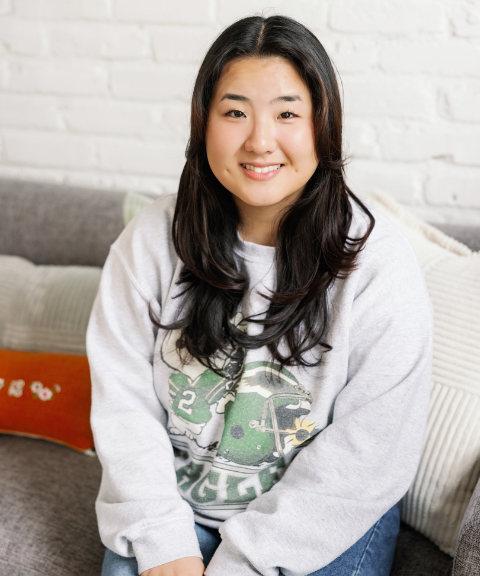
Jisu Pyo
Korean-American Therapist · She/Her
Sessions in: English & Korean
Jisu is a Korean-American therapist in Pennsylvania who provides therapy in both English and Korean. With lived experience as an immigrant and a deep understanding of cultural identity, intergenerational pressure, and the first-gen experience, she offers a compassionate space for clients navigating anxiety, depression, grief, life transitions, and relationship challenges.
She specializes in therapy for Asian-American and Person of Color communities, using a trauma-informed, multicultural lens. Jisu integrates CBT and mindfulness to support clients through self-esteem concerns, academic or career stress, and bicultural identity work — all with warmth, respect, and a sliding scale for those who qualify.
Work With Jisu
Amy Huang
Chinese-American Therapist · Philadelphia, PA
Sessions in: English & Cantonese Chinese
Amy is an Asian therapist in Philadelphia who can provide therapy in both Cantonese Chinese and English. As a child of two Chinese immigrants, she has firsthand experience navigating cultural identity, intergenerational expectations, and learning to embrace her roots. She is dedicated to serving first-generation American and BIPOC communities and breaking down the stigma that often surrounds mental health.
Her approach is warm, person-centered, and collaborative, supporting clients with anxiety, depression, relationship difficulties, identity concerns, and life transitions. Amy has a passion for helping adult children of immigrants and bi-cultural individuals, and is committed to a culturally affirming, non-judgmental space where people feel heard, respected, and validated.
Work With AmyYou Deserve Support That Makes Space for All of You.
How Does Seeing an Asian Therapist Help?
Support without Translation

Cultural Understanding
Therapists are more familiar with Asian values, traditions, and family dynamics.
Language Accessibility
Sessions with Amy Huang can be conducted in English and/or Cantonese Chinese. Sessions with Jisu Pyo can be conducted in English and/or Korean.
Reduced Stigma
Many Asian therapists acknowledge and address cultural stigmas surrounding mental health.
Tailored Coping Strategies
Therapy approaches consider cultural expectations, such as familial obligations.
What Does the Research Say About Culturally Responsive Therapy?
Research shows that culture matters in the therapy room. Culturally adapted mental health treatments have been associated with greater symptom improvement among racial and ethnic minority clients, while clients report lower satisfaction when cultural concerns important to them aren’t addressed in treatment.
For women of color, cultural responsiveness may also make it easier to stay engaged in care. One review of psychological interventions for pregnant Latina and Black women found that studies using culturally adapted treatments had an average 10% dropout rate, compared with 19.9% for treatments without cultural adaptations.
SOURCES:
- Arundell et al. (2021), Clinical Psychology Review. (Read more.)
- Meyer & Zane (2013), Journal of Community Psychology. (Read more.)
- Ponting et al. (2020), Clinical Psychology Review. (Read more.)

Frequently Asked Questions:
Get StartedBecause you may not want to spend your sessions explaining your family, your culture, or why certain things feel so heavy. An Asian therapist can bring shared cultural understanding of things like family expectations, filial piety, immigration, mental health stigma, and the pressure to be “the strong one,” so you can get to the real work faster. Wanting that isn’t about avoiding other therapists; it’s about finding the fit that feels safest to you.
No. Asian American communities are diverse, and you don’t need to be an immigrant, first-generation, or fluent in any particular language. Whether you were born here, immigrated, grew up between cultures, or are still figuring out where you fit, you’re welcome, and sessions can be held entirely in English.
Sessions with Amy Huang can be conducted in English and/or Cantonese Chinese. Sessions with Jisu Pyo can be conducted in English and/or Korean. If you’re looking for support in another language, contact us and ask about availability.
That’s common, and you’re not alone in it. Many families have been taught to handle struggles privately or to see therapy as unnecessary or shameful. You don’t need your family’s approval to take care of your mental health, and your therapist can help you think through how, or whether, you want to talk with them about it. Therapy is your own private space, and your therapist can’t share what you discuss with your family without your permission, with limited exceptions required by law.
Yes. Therapy isn’t about blaming your family or asking you to give up your values or culture. It’s about understanding the pressure you carry, getting clear on what you need, and finding ways of moving forward that feel sustainable to you. Your therapist will meet you where you are and won’t push you toward a choice you aren’t ready to make.
We offer in-person therapy appointments, weekdays and weekends, at our conveniently located office in Center City Philadelphia. Our office is accessible by SEPTA, and close to several parking garages.
Jisu Pyo offers a sliding scale for clients who qualify. Contact us to ask about availability and eligibility.
Absolutely! If requested, we can provide you with a Superbill at the end of the appointment for you to submit to your insurance provider for reimbursements of any out of network benefits you have on the plan.
If you are unsure about your exact out of network benefits, you can contact the Member Services, Customer Service, or Behavioral/Mental Health number on the back of your insurance card, and ask the following questions:
- Does my health insurance plan include out of network benefits for mental health – office visit?
- Do I have a deductible? If so, what is it, and how much has been accumulated so far?
- Does the deductible apply to mental health – office visits?
- Does my plan limit how many sessions per calendar year I can have? If so, what is the limit?
- Do I need written approval from my primary care physician in order for services to be covered?
- What would be covered if I worked with an out-of-network provider?
- What is the process for me to be reimbursed for out of network benefits?
If you do not have insurance or have financial hardship, Openpath Psychotherapy Collective offers an option for therapy at a sliding scale fee. You can also contact the Loveland Foundation and the National Queer and Trans Therapists of Color Network for mental health funding opportunities.
Get Started Today
Improve Your Mental Wellbeing and Find Peace in Everyday Life With Help From Qualified Black Therapists & Therapists of Color